I don't know how it's done in the internet age but I think at least this was once a true practice pre-internet. The list here is exhaustively comprehensive (and somewhat satirical). I'm curious to learn more about this practice and how it standardized.
Saturday, January 31, 2009
Gay Hanky Code
I don't know how it's done in the internet age but I think at least this was once a true practice pre-internet. The list here is exhaustively comprehensive (and somewhat satirical). I'm curious to learn more about this practice and how it standardized.
Friday, January 30, 2009
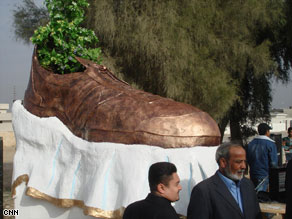
Shoe-Thrower Monument Removed
Assisted by kids at the Tikrit Orphanage, sculptor Laith al-Amiri on Tuesday erected a huge brown replica of one of the shoes hurled at Bush last month by journalist Muntadhir al-Zaidi during a press conference in Baghdad.
But officials from Salaheddin province told CNN that the monument was removed after a request from the central government, which has charges pending against al-Zaidi -- now in an Iraqi jail.
Link
Thursday, January 29, 2009
Your Brain on Fiction
Boing is too good at breaking interesting stories. Damn them! In this article which quotes "The Western Interstate Commission for Higher Education (WICHE) Mental Health Program" the journal, Psychological Science will publish a report that says that reader mirror the actions of characters from the same brain placed than if they were performing the actions.
To me this would provide clues about entering another person's brain via fictional narratives. If an experience is common it will be accessible to a reader that tries to construct it. Or if an experience is expressed through the language of common experience then even though it may be exotic it can also be digestible. If I wrote about walking on the moon and used metaphors of walking in a blow-up castle, or walking underwater, then it may be easier to convey than if I tried explain that the ground on the moon is hard but I'm not as heavy and there is very little air resistance.

Link to the article.
To me this would provide clues about entering another person's brain via fictional narratives. If an experience is common it will be accessible to a reader that tries to construct it. Or if an experience is expressed through the language of common experience then even though it may be exotic it can also be digestible. If I wrote about walking on the moon and used metaphors of walking in a blow-up castle, or walking underwater, then it may be easier to convey than if I tried explain that the ground on the moon is hard but I'm not as heavy and there is very little air resistance.
Link to the article.
Wednesday, January 28, 2009
Subscribe to:
Posts (Atom)